Showing posts with label Edible and Sustainable Gardening. Show all posts

Sunday, May 8, 2011

Lots of changes

Where to even begin?  Beats me, which probably says a lot about why I haven't posted in months.  So lets just gloss over unpleasant things like moving in between snow storms, losing power repeatedly, having first bronchitis, then pneumonia, and discovering that the old place was infested with black mold on the walls after we moved out.

My new home includes the opportunity for most of my favorite things: gardening, fiber, a large yard for Riley, a barn for the dairy goats, and a new flock of chickens.  The new place has a greenhouse and potting shed, so we've been starting seeds weekly for the last couple of weeks. 


I'll confess that I've had trouble for years getting my own seeds started.  Too hot, too cold, not enough light...  Well, not a problem anymore.  These seeds are popping up, no problem.  Many of them are already developing their first sets of true leaves.  That's trombetta squash in the front, then lots and lots of sunflowers.  I counted fourteen dozen sunflowers and six dozen zinnias, among other things.  We want lots of cutting flowers in addition to our veggies and herbs.


Riley gives it all two paws up.  (I was trying for all four paws up, but missed the moment!)


Sunday, July 11, 2010

Chickies!!


This post is two weeks old, will get a newer post up soon!  So much more to share.

We have some new additions to our laying flock. Two of our hens became broody, and so we set them up in a couple of dog crates for some quiet solitude, and three weeks later, voila!  We have baby chicks.  So far we have three from the first hen, Smoke, and one from the second hen, Ash, though I'm not certain that Ash is done hatching babies just yet as she started 3-4 days later than her sister Smoke.

For those of you not in the know, hens do not need a rooster present to lay eggs, but those eggs are not fertilized.  Because we do have a rooster, the eggs we collect each evening have the potential for hatching a baby chick, given the right conditions.  Those can be man-made, but a broody chicken is the easiest way to go.  Once a hen has accumulated a nest of eggs, if she is broody she will sit on the nest, incubating the eggs and rolling them over.  Upon hatching, she will begin to teach the chicks how to hunt and peck at food, even mashing up larger food to feed to the babies.  Unlike other baby birds, they are up and following mama within a day of hatching.

We have four varieties of chickens in our flock.  Our rooster is a gold-laced Wyandotte.  Among the hens I have silver-laced and blue-laced Wyandottes and Ameraucanas.  This means that all of the chicks are mixed varieties, though they are exhibiting  certain plumage patterns already.  One looks Ameraucana, one looks blue-laced, and two look silver-laced.  It'll be interesting to see what they look like as they grow up.

We finally named the doelings Mary, Bridget and Bess, three great queens from the British Isles.  Bess is the large, pale doeling.  Bridget is the mostly black doeling and Mary is the calico, which somehow in our minds most closely resembles plaid.  They are friendly and playful, loving to run the length of the pasture in the cool mornings.

Of course, all of the animals, plants too for that matter, are telling me quite clearly that the world is heating up outside.  The plants are wilty, and all of the animals are taking it easy in the shade.  Everyone has access to lots of water, and when it really heats up we'll set up misters to help keep everyone comfortable.

Speaking of plants, I'm trying out a new system for tying up tomatoes this year.  Using a simple A-frame made of 1x3 lumber and a piece of electrical conduit, each tomato is tied with a piece of twine around it's base and up to the conduit.  Every couple of days I simply twist leader (main stem) around the twine.  That's it.  No finding scissors to cut bits of string, or oops, the stake fell over.  Just another twist around the twine.  All the tomatoes are tied up in just a few minutes, and they look fabulous.

I'd heard about this method, and need to give kudos to this humorous youtube video for the clear explanation about the twisting.
The beans are finally sprouted and climbing up their poles.  You can even see the painted lady heirloom beginning to show it's beautiful red flowers.

Sunday, May 9, 2010

The light at the end of the tunnel...

For awhile I was sure the light at the end of the tunnel was the proverbial oncoming train, or even worse, that the light was cut due to budget constraints, but I'm finally there.  The end of the tunnel.  The 2010 Nevada County Grown Farm Guide is off to the printer, the 20th anniversary land trust event was a success, and everything wrapped up last Saturday with the spring native plant sale. Whew, regular programming can now resume. 

In case I hadn't said, I've been volunteering with the local chapter of the native plant society as a way to hone up on my plant id skills.  So Saturday found me cashiering at the biennial plant sale. Riley helped too.  You can see him here checking out a selection of native plants.

Here's what I can home with: monkey flower 'terra cotta', a hot pink penstemon, coral bells 'red bells',a couple of bleeding hearts and blue-eyed grass. And then we picked up some 6-pack plants at Eisley's, including parsley, celery, chard, some cosmos and strawberries.  Here's a wheelbarrow full of the day's haul.

Last Sunday started out with planning the expansion of the goat pens in preparation for the new arrivals expected at the end of the month, testing out the drip irrigation system and getting supplies. Sadly, when one has been working continuously for 5 weeks, the weeds have an opportunity to take over the unmulched portions of the perennial garden, so before I could really plant anything I commenced with the weeding. 

Riley liked weeding. We removed quantities of annual grasses, chickweed and a non-native mallow, as well as the ever present blackberry sprouts. The vegetable portion of the yard is ready for planting, having been thoroughly sheet mulched in the fall  with straw, hay, and goat poop from the goat pen. 

And then I sprained my ankle.  Kind of put a stop to my gardening plans for the rest of the week.  Troy did a great job of stepping up (since I literally couldn't) and continued weeding out the blackberries and installing a fence to keep the chickens out of the garden.  Still gimping around, we managed to get most everything planted this afternoon

Sunday, March 14, 2010

Daylight Savings Rant


Last fall during the bi-annual time change, a friend of a friend on facebook posted something to the effect that daylight savings time was a relic of farmers and farming practices, and since farmers are a minority of the population, Day Light Savings should be removed.

As a homesteading/farmer type of person, I immediately and vehemently objected to his statement.  After all, he wasn't the one who was now milking goats in the dark because of the sudden time change at, nor any of the other chores that must be done before and after work.  My work hours certainly didn't change just because the time on the clock did, and instead all of our diurnal actions are shifted for this bit of tomfoolery.

So why do we have DST?  DST as a concept was suggested as early as 1794 by Benjamin Franklin, and was adopted in the United States in 1917 by an Act of Congress.  The basis for DST has always been energy savings, the idea being that people will consume less energy if they are maximizing their use of daylight hours. Unfortunately, studies don't bear out this assumption, but countries around the world continue to follow this principle.

Here's an excerpt from Wikipedia:
The practice is controversial. Adding daylight to afternoons benefits retailing, sports, and other activities that exploit sunlight after working hours,but causes problems for farming, evening entertainment and other occupations tied to the sun. Traffic fatalities are reduced when there is extra afternoon daylight; its effect on health and crime is less clear. Although an early goal of DST was to reduce evening usage of incandescent lighting, formerly a primary use of electricity, modern heating and cooling usage patterns differ greatly, and research about how DST currently affects energy use is limited and often contradictory.

Who really benefits from DST?  Well, the pool and BBQ industry fronted the biggest lobbying checks that got the US Government to add an additional 4 weeks per year of DST, with three weeks in the spring and one week in the fall beginning last year.  Those don't sound like farmers to me!!

So tomorrow morning the sun will not rise until 7:15am and I'm back to milking in the dark in order to get to work on time. 

DST or not, spring is just around the corner, and I have the evidence!

Goats in the sunshine

Flowering quince

The rosemary is beginning to bloom

As is the calendula

And the lilacs are preparing to spring forth!

Tuesday, July 14, 2009

Study finds native bees thriving

This blip comes to you courtesy of California Agriculture, a University of California's peer-reviewed journal of research in agricultural, human and natural resources. For a free subscription or to read the entire article, go to: http://californiaagriculture.ucop.edu.

Evidence is mounting that pollinators of crop and wildland plants are declining worldwide. Our research group at UC Berkeley and UC Davis conducted a 3-year survey of bee pollinators in seven cities from Northern California to Southern California. Results indicate that many types of urban residential gardens provide floral and nesting resources for the reproduction and survival of bees, especially a diversity of native bees. Habitat gardening for bees, using targeted ornamental plants, can predictably increase bee diversity and abundance, and provide clear pollination benefits.


Frankie G, Thorp R, Hernandez J, Rizzardi M, Ertter B, Pawelek J, Witt S, Schindler M, Coville R, Wojcik V. 2009. Native bees are a rich natural resource in urban California gardens. Cal Ag 63(3):113-120. DOI: 10.3733/ca.v063n03p113

Saturday, May 30, 2009

GardenRant: The Truth About Jeff Gillman

Jeff Gillman is a professor of horticulture at University of Minnesota where he conducts research about "organic gardening" and has written numerous articles and a few books. You can read my book review about his latest book, The Truth About Organic Gardening, in Briar Patch's newest newsletter, due out this week.

By the way, he later claims he was a little harsh on the Garlic and Peppermint Spray. " I do think it might work for insects, but for plant diseases?"


Courtesy of Amy Stewart over at GardenRant.

Monday, May 18, 2009

Little Crop of Horrors

Did you know that Michelle Obama's elitist organic garden could simultaneously cause starvation, obesity and cancer? Watch the Daily Show's tongue-in-cheek response to elitist concerns about organic gardening.

By the way, this isn't all laughs. Pro-pesticide group MACA (Mid America Croplife Association) wrote to Michelle Obama, defending the use of "crop protection products." One official with the pro-pesticide group said, “While a garden is a great idea, the thought of it being organic made [us] shudder.” MACA represents agribusinesses like Monsanto, Dow AgroSciences and DuPont.

The Daily Show With Jon StewartM - Th 11p / 10c
Little Crop of Horrors
thedailyshow.com
Daily Show
Full Episodes
Economic CrisisPolitical Humor

Wednesday, November 12, 2008

Working Landscapes

I'm often amazed by the number of free programs that are offered that nobody seems to know about. Take for instance Nevada County Resource Conservation District (www.ncrcd.org). This is a government funded agency which promotes responsible resource management by educating and assisting landowner and land managers through education, leadership, technical and financial assistance, and project facilitation. And it's almost all free!

Today I attended a free brown bag lunch workshop entitled "Working Landscapes: The Environmental Benefits of Grazing" presented by NCRCD. What are working landscapes? Here's a quote from one of the handouts. "Working landscapes consist of farms, ranches and actively managed forestlands. California' working landscapes provide jobs, local tax base, a variety of environmental services, scenic open space, and much of the food and fiber Americans consume."

Today I'll summarize the first of the three speakers, Sheila Barry, UC Livestock and Natural Resources Advisor for the Bay Area. Her focus was on UC research documenting the many benefits of managed grazing, especially fire fuel management, watershed protection, wildlife habitat, increased biodiversity, maintenance of critical endangered species' habitat, recreation, and providing on going, consistent stewardship.

Unfortunately, there are many negative perceptions around ranchers and grazing, including leftover cow pies, overgrazing, and how to manage a changed landscape. Perhaps the most important part of these perceptions is that the successful stories are not connected in the minds of the public. However, there are only a few bad apples among ranchers and farmers. Most ranchers share environmental concerns; in fact, their livelihoods depend preserving clean water, biodiversity and healthy soils, and prove to be excellent stewards of the lands they own or manage.


Saturday, October 11, 2008

First Frost!

Thursday night was our first night of frost, followed by our second night on Friday. It was enough frost to burn the tender foliage of the nightshade and squash families. I want to put frost fabric over the tomatoes to extend the season for as long as possible, although I'll probably pull out the eggplants and squash plants. The peas and brassicas, celery and parsley look quite happy. The upper garden doesn't seem to be as frost damaged, but I'll still need to spend some time winterizing everything.

What do I mean by winterizing? I want to divide and move some plants around, wrap up fall weeding and pruning, pull out annuals, cover the ground with rice straw, which serves as erosion control and organic mulch. Why rice straw? All straw has some seed in it, so if you use a grass straw like oat or wheat, you'll end up with more grasses to weed later. Rice seed will not germinate in normal garden conditions, so it's preferred for use as mulch material. I've also planted a legume mix cover crop in the beds I'm not using over winter, which will fix nitrogen, increase organic matter and keep the soil from being bare.

The weather has been tricky to manage with the chicks. They are not quite feathered enough to stay out all night, especially not with frost in the air. We have winterized the chicken coop to keep it dry and protected from wind, and the coop is placed behind the house where it tends to be calm and protected anyway, but still not warm enough for our 6-week old chicks. They go out each morning and are collected each evening and brought inside.
We arranged the chicken yard with chick havens where the big, bad rooster (Kazoo) can't get them.

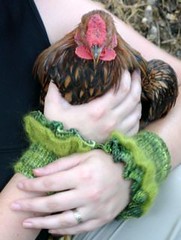
I spent the afternoon getting my booth ready for the Placer Farm & Barn Tour tomorrow. I think I'm ready. All of the wristwarmers are tagged, the big stuff is in the car and the small stuff is all packed and ready to be carried out in the morning. If you come out, be sure to stop by Thompson Ranch and say hi!

Sunday, August 24, 2008

Life

This weekend has been long, with lots of ups, and unfortunately, some downs. When I got home Friday, this huge, beautiful single rose was waiting for me. "Just because," said DH (darling husband).

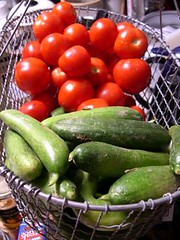
Saturday started with a trip to the farmers market, where I scored some great tomatoes and cucumbers for food preserving. I mentioned to the farmer, Lisa of Lisa's Petals and Produce, that I wanted some paste-type tomatoes for making tomato soup, and she offered up a great variety of which she had several pounds that were a little soft and were perfect for my purposes. And when I said I also wanted to make pickles, out came the tray of "too small" cucumbers that were, again, perfect. More on that in a bit.

A stop by the nursery to pick up some broccoli starts. I will start kale and peas from seed, but it seems like I always start my fall broccoli too late and never get good production, so I'll just get a jump with the transplants. They are going in a
bed that had bush beans which are now done producing, so they'll have plenty of time to get established before the weather turns cold.

Saturday night was th
e Nevada County Land Trust's annual fund-raising concert. It was at a new venue this year, Pilot Peak Winery, which turned out to be beautiful. By the time the second performer finished, it was after 11pm, the stars were out and the waning moon was just popping up over the horizon...

Let's just assume that after two glasses of wine at the concert (it was a winery, afterall) and getting home just after midnight, all I really wanted to do was sleep. So when I was wakened by chicken
squawking at 3am, I was pretty grumpy. Went out to investigate, and the chicken coop was still secure, though the perch had fallen down. Since I hadn't installed the hinges on it yet, it was possible that it just fell under the weight of the chickens shifting on the perches. It wasn't until 6:45 that my husband spotted the gray fox just down the hill from the coop. We thought everything was ok, until we noticed that Nina, our sole remaining hen from the original group, was bleeding around her beak. Her face had been scratched and the bottom of her beak half torn off. The fox had been able to stick a paw through the mesh and managed to get at her on the perch. We tried to clean up the blood to assess the damage, but you could tell she was in a lot of pain. We kept her under close observation, and forced her to drink, but she couldn't eat or drink with her beak damaged. So once again, my courageous husband took care of things. And then we attached fine wire mesh to the more open mesh of the large door. I don't think anything short of a bear could get to our chickens inside the coop now. And I attached the perch to the wall, the last, finishing touch.

Numbed, like my poor rooster, I focused on preserving the extra produce I purchased on Saturday. We put up four pints of garlic dill pickles, six cups of an Indian influenced relish and three and a half quarts of tomato soup. I want to put up some extra jars each week so that we can enjoy the fresh flavors deep in winter, when the produce is just a memory.

Tuesday, July 8, 2008

Guerrilla Gardening

No, I'm not about to tell the joke about winter squash plants being the equivalent of large primates sitting wherever they want in the garden. (Although that is exactly my acorn squash are doing at the moment - more pictures later.)

The basis of guerrilla gardening is the improvement of land at a community, grass-roots level. Or in t
his case, hardy perennials, even fruit trees and corn! The term was coined in the 1970's in New York to describe the clandestine gardening activities involving empty lots. The basics are simple: find an ignored, empty bit of orphaned land (like a median strip), recruit help in the neighborhood via community boards or join an existing "cell", set a work date and clean up the area. Of course, it's also recommended to leave the area clean, post some signs at the site or nearby about the rejuvenated space and be prepared to water the plants. Why does this strike my fancy? Being a rebel while doing one of my favorite activities and leaving the world just a little bit more beautiful are excellent reasons to be a guerrilla gardener.


Now, if I can just get these Aussies to raid the weeds in my garden, my life just might be complete until the next round of weeding! Perhaps this isn't the best example of clandestine activities, but it's certainly eye-catching.

Saturday, June 7, 2008

Creative Potting

I garden on a hillside with very little topsoil, so everything is in raised beds, terraces and containers. As large pots increase exponentially in price according to size, most of my containers are unconventional to say the least.

I've used old-fashioned metal dryer drums, which have natural drainage holes for larger items like my blueberry bushes and pomegranate tree/shrub. Did I mention they're usually cast-iron steel? Those things last forever, and are great large planters that you never have to worry about rotting like half oak barrels.

Next was the BBQ pit planter made from a metal 55-gal drum. It was cut in half from top to bottom, and then welded to bent rebar legs. We discovered this gem hidden in the vinca on the hillside under our studio. You'd never have seen it from above, but I noticed it poking through the foliage while walking up from the river one afternoon. It was very rusted,
which made it easy to snap off the welds on the legs, and let it rest on the ground, where it now houses orangemint and catmint to keep them under control and out of mischief!


The old, rusted wheelbarrow has had the handles and wheel removed, and snugged into the dirt. The goblin flowers, a type of blanket flower, don't mind the varying depth of the planter and have filled in beautifully.

My latest pots were unearthed in the vinca by my husband - two white ceramic toilet tanks! I had run out of places to put the zinnias acquired while I was in Fresno for Mother's Day and these provided the perfect solution. Nice depth, nice ceramic finish, drain holes - what more could a girl ask for?

Oh, I should mention my worm bin. Many people have those nice, layered, stacking affairs. Not my worms though. My worm bin is the body of an old refrigerator, sans door. We added drainage holes to keep the worms from drowning in winter. The beauty of the fridge is the sheer volume - with that much cubic footage, the worms have plenty of room to self-regulate according to the seasons.

If you are willing to be flexible with your potting options, you'll find there are many containers waiting to be found or repurposed.

Tuesday, April 29, 2008

Sustainable Agriculture Blog

What is sustainability? Is it important? Why? Give some examples of sustainable practices that could (some may already be) be implemented to improve the sustainability of agriculture? And, what are some ways that the consumer can contribute to the sustainability of agriculture?

Wow! Again - go look at some of my previous posts! Just kidding. I'll summarize my favorite ideas:

Reduce your carbon footprint - plant a garden! Never mind the fuel you save, using natural compost and green manure cover crops actually acts as a way to sequester carbon. Even a small patio container garden saves on overall emission contributions.

Buy locally. You can argue that it doesn't save money to buy from a local farmer. However it's proven that locally spent dollars generate more money, income, jobs, etc, within the community. Besides, I'd rather have a fresh juicy tomato or peach picked that morning than one stuck in a refrigerated box car for transportation. Also, farmers tend to have more interesting and flavorful heirloom varieties, which preserves our genetic seed diversity.

Did you know that THE big incentive for transporting food long distances is the ability of corporations to deduct the transportation costs on their taxes? So basically, our tax payer dollars are subsidizing the transportation of foods long distances, so that we get second rate foods at a "bargain" price...

Let your representatives know you support sustainable ag. The pending Farm Bill has the potential to turn our nation's ag production around, but not without your voice and support. Several recent university studies have proven that organically produced crops are equal or nearly equivalent in productivity and cost as their conventional counterparts. However, most large-scale farmers continue with their existing practices because of the financial incentives provided by the government to do it that way.

Tuesday, April 15, 2008

Globalization

The information posted this week points out some of the negative impacts of the globalization of agriculture. What are some positive aspects of globalization? How does globalization impact your life? In your blog feel free to reflect on the negatives as well, many of which were pointed out in the readings for the week.

This touches on many of the issues I hold near and dear, namely, how can something which was manufactured or produced thousands of miles away really be good for me, the environment, or the global economy? Sure, it's nice to get raspberries for New Year's Eve champagne, or mangoes year round. And chocolate? I still give in to the impulse buy for a Hershy with almonds at checkout, even though it is not fair trade and probably produced using child labor and DDT. None of these things would be possible without the globalization of our economy.

I think the most important and overlooked commodity related to agriculture is not the seeds and fertilizers, but the knowledge needed to produce crops. Growing food is a knowledge-intensive endeavor, as anyone who has attempted a first time garden will understand. Annuals, perennials, dry or irrigated farming are just the tip of the iceberg. Most growers I talk to always confirm this idea that farming and gardening provide a constant schoolroom for learning. Cheaper and faster (almost instantaneous) communication has meant the translation of growing systems to far-flung regions, and the sharing of ideas and traditional systems has lead to new research focusing on not just the Green and Gene Revolutions, but especially the development of sustainable ag techniques.

Wednesday, April 2, 2008

Organic Food Production

This week Blog about what the term "organic" means in the U.S. Is it good or bad for the food industry and the consumer that the term was legally defined by the federal government? Are organic foods better for people and the environment than traditionally produced food? What are the drawbacks to organic food production? How do you feel about the "big business" of organic i.e. retailers like Whole Foods??? Make sure you are supporting your claims with valid evidence....Include anything else that interests you...

Holy crap - like I could put everything I think about "organic" food production into one blog topic. I read entire books on this subject, have spent the last three years of my life selling organic farm and garden supplies and am preparing my grad school application to get a PhD in sustainable ag!

Seriously though, I recently posted about a series of independent short films about sustainable/organic food production and its impacts. I really liked one of the points made in Ripe for Change, that for not just organic production, but for sustainable production, you look at other factors than just using non-synthetic inputs, especially socio-economic and ecological factors. For example, most of our world concerns about hunger really are issues of poverty and distribution rather than food production.

Some of the biggest drawbacks to defining organic is the abuses that can then take place when the letter, but not the underlying intent, of the law is followed. For example, many big-ag corporations and farms are simply substituting non-synthetic pesticides and fertilizers for their synthetic forms and are otherwise carrying on as normal. Loop holes for increasing organic herd size were abused by several large scale dairies seeking to produce organic milk. Lack of action by the USDA-NOP in response to complaints about label-violations for large scale organic dairy producers such as Horizon and Aurora (producers of "organic" milk for Safeway, Costco and large markets) has resulted in a class-action lawsuit for misrepresentation and other violations.

It really boils down to the fact that a lot of truly organic production relies on integrity, which is hard to legislate.

Many large scale organic productions still rely heavily on petroleum for fuel and transportation. Is it really organic when it traveled several thousand miles? Can we trust the so-called organic practices of Mexico or China? Is it better to buy locally produced, uncertified produce from a farmers market or certified organic in the supermarket imported out of season from a foreign country? Is the food still as nutritious when not all of the practices are followed? Are the farm laborers being paid a living wage?

Unfortunately, the grass isn't necessarily greener on the other side depending on one's practices. Many of the natural and organic inputs used in organic and/or local farming such as rock powders and natural pesticides and fungicides, such as sulfur and copper, are strip mined and shipped to distributors before ending up in the soil or on plants. Also, natural sulfur and copper are dangerous compounds which must be used with as much care as their synthetic counterparts - breathing masks, gloves, goggles and long-sleeved clothing are recommended to as protective gear for the home user, and required for the commercial grower. People have a mistaken notion that natural equals safe to which I reply, "Arsenic is completely natural and will kill you just as dead."


The lack of good research into organic productivity is finally changing. A recent 13-year study at the University Wisconsin published in the March-April 2008 issue of Agronomy Journal found that organic cropping systems can be as productive, or nearly productive, as conventional systems.

Conventional food producers would have you believe that food is equally tasty and nutritious. However, over 40 studies, summarized by The Organic Center, keep proving that organic produce is more nutritious than it's conventionally produced counterparts.


However, the spirit of the eco-farm movement continues. Permaculture, biodynamic and local and sustainable ag are current hot topics for research. These farming regimes are the answer for improving farming practices in marginal areas around the world where the Green Revolution failed to improve local agriculture, and in some cases increased the rates of soil erosion, desertification and removed local farmers from the land.

Even the United Nations has changed it tune about importance of organic production in their most recent FAO report, Organic Agriculture and Food Security. Here are some highlights from the report:

  • Global food supply is sufficient, but 850 million are undernourished and go hungry
  • Use of chemical agricultural inputs is increasing; yet grain productivity is dwindling to seriously low levels
  • Costs of agricultural inputs are rising, but commodity costs have been in steady decline over the past five decades.Knowledge is increasingly provided through fast information technologies, but nutritionally related diseases are rising
  • Industrialised food systems cause deaths through pesticide poisonings and high numbers of farmer have committed suicides, while millions of jobs have been lost in rural areas.
In contrast, organic agriculture offers an alternative food system that improves agricultural performance to better provide access to food, nutritional adequacy, environmental quality, economic efficiency, and social equity. This is crucial if agricultural production in developing countries is to rise by 56 percent by 2030 to meet nutritional needs, as stated in the Report.


Want to learn more? In addition to the eco-farm links above, check out the following links for more info:
www.sare.org
www.attra.org
www.organicconsumers.org

Want to eat local/organic food but don't know where to find it or what to do with it?
www.sustainabletable.org
www.localharvest.org
www.slowfoodusa.org
www.cafarmersmarkets.com