Showing posts with label chickens. Show all posts

Saturday, October 30, 2010

Alouetté, gentille alouetté...


Warning - this contains some detailed photos of our us harvesting our excess roosters.

This summer our broody hens hatched out seven chicks, of which four turned out to be boys.  Now, hopefully you know by now that you don't need roosters for hens to lay eggs.  Additionally, when you have more than one rooster fighting for dominion over the harem things can turn nasty.  Our dominant, three-year-old rooster Kazoo will not share the coop with the young upstarts, so every night we have to go out with a flashlight and rescue the recalcitrant boys off the roof of the coop and shove them in with everyone else. Since it's hard to find homes for excess boys, we decided to take the plunge and do our first chicken harvest.

Neither of us had harvested chickens before, so we watched some youtube videos.  I liked this one the best. We dressed in Troy's cooking clothes.  Set up an ice bath, trash can, hanging hook, cutting board, and knives, and caught us a rooster boy each.

We didn't have a cone, so we simply tied them up by their feet and bleed them out by cutting a carotid artery on the side of the neck.  The chickens are already in a semi-stupor when held upside down, and once they loose significant blood pressure, it all ends pretty quickly. 
Troy decided he wanted to try skinning his chicken.  Here it is after being rinsed off.


I wanted to go traditional by plucking my bird.  There is definitely a knack to it, and while there are a few pins left in the skin, it wasn't that hard.  This is my bird after plucking.  Really does look like one of those imitation rubber chickens.

There's the crop.  Don't want to cut that open accidentally.  This is where all of those biology dissections really come in handy.  Pulling apart viscera is the same on all animals.

Yes Mom, that's me doing the nitty gritty.  I really did stick my hand repeatedly into the chicken.  (Ask me about the time I didn't eat chicken for several months after being threatened to stick my hand into the chicken or go without.)

When we were done we rinsed out each carcass and placed them in the ice bath to finish cooling rapidly, finally putting them in a freezer bag and into the freezer.  Since these birds are all from breeds that specialize in egg laying, they don't have the plump breasts that meat birds do, so these won't be great roasting birds.  Also, at four months of age are probably beginning to toughen up just a bit.  Most roasting birds are harvested at 10-12 weeks old.  These'll probably go into a soup or stew pot.

Sunday, July 11, 2010

Chickies!!


This post is two weeks old, will get a newer post up soon!  So much more to share.

We have some new additions to our laying flock. Two of our hens became broody, and so we set them up in a couple of dog crates for some quiet solitude, and three weeks later, voila!  We have baby chicks.  So far we have three from the first hen, Smoke, and one from the second hen, Ash, though I'm not certain that Ash is done hatching babies just yet as she started 3-4 days later than her sister Smoke.

For those of you not in the know, hens do not need a rooster present to lay eggs, but those eggs are not fertilized.  Because we do have a rooster, the eggs we collect each evening have the potential for hatching a baby chick, given the right conditions.  Those can be man-made, but a broody chicken is the easiest way to go.  Once a hen has accumulated a nest of eggs, if she is broody she will sit on the nest, incubating the eggs and rolling them over.  Upon hatching, she will begin to teach the chicks how to hunt and peck at food, even mashing up larger food to feed to the babies.  Unlike other baby birds, they are up and following mama within a day of hatching.

We have four varieties of chickens in our flock.  Our rooster is a gold-laced Wyandotte.  Among the hens I have silver-laced and blue-laced Wyandottes and Ameraucanas.  This means that all of the chicks are mixed varieties, though they are exhibiting  certain plumage patterns already.  One looks Ameraucana, one looks blue-laced, and two look silver-laced.  It'll be interesting to see what they look like as they grow up.

We finally named the doelings Mary, Bridget and Bess, three great queens from the British Isles.  Bess is the large, pale doeling.  Bridget is the mostly black doeling and Mary is the calico, which somehow in our minds most closely resembles plaid.  They are friendly and playful, loving to run the length of the pasture in the cool mornings.

Of course, all of the animals, plants too for that matter, are telling me quite clearly that the world is heating up outside.  The plants are wilty, and all of the animals are taking it easy in the shade.  Everyone has access to lots of water, and when it really heats up we'll set up misters to help keep everyone comfortable.

Speaking of plants, I'm trying out a new system for tying up tomatoes this year.  Using a simple A-frame made of 1x3 lumber and a piece of electrical conduit, each tomato is tied with a piece of twine around it's base and up to the conduit.  Every couple of days I simply twist leader (main stem) around the twine.  That's it.  No finding scissors to cut bits of string, or oops, the stake fell over.  Just another twist around the twine.  All the tomatoes are tied up in just a few minutes, and they look fabulous.

I'd heard about this method, and need to give kudos to this humorous youtube video for the clear explanation about the twisting.
The beans are finally sprouted and climbing up their poles.  You can even see the painted lady heirloom beginning to show it's beautiful red flowers.

Thursday, May 14, 2009

Milk drinking fools

No, I'm not referring to my husband. I'm talking about my chickens.

For weeks they have watched the evening milking. Black hen in particular would stand around, intently observing for upwards of ten minutes. This is a very long time in chicken time. I wasn't sure what the fascination was. Had she watched milking before? Could she smell the calcium in the milk?

I'd heard about feeding chickens old milk and yogurt, or failed cheese. So when Maharani put her foot in the milking jar, rendering the milk unclean for human consumption, I decided to put some out for the chickens. I was in no way prepared for the chickens' enthusiasm for this treat.

They now expect some everyday. They wait at the stanchion, eyeballing the goat, and get excited when I walk by with a mason jar. Nevermind that it may only be my water jar, I'm followed right inside my studio for anticipated treats.

Sorry there's no sound on the video, but enjoy the antics of my milk drinking chickens!


Monday, May 11, 2009

Chickies Go Outside

The new Silver Laced Wyandotte chicks have been eating, growing, pooping and therefore progressing nicely in their transition to the great outdoors. Saturday was their first day outside. So exciting!


You may recognize the chicken tractor being used once again as a chickie transition pen. It allows the gradual, but protected, introduction of new chickens to the flock. In another couple of days we'll prop up one corner, allowing the small ones the opportunity to safely explore the bigger world, but still a place to get away from the bigger chickens, especially the rooster. Unfortunately, we haven't had another hen attempt to mother our chicks. We miss our granny hen!


Of course, all of the adults had a good look at the new arrivals. Nobody seemed too upset, just curious. From left to right we have Squish Face (Ameraucana), Prius (Ameraucana), Kazoo (Gold Laced Wyandotte rooster) and Black Hen (Black Australorp).

Sunday, May 10, 2009

Happy Mum's Day


I'm not a mom by the standard definition, in that I've never given birth. And yet, I've done the mom thing, as much as anyone can who hasn't gone the pregnancy/birth route. Being significantly older than my full-blooded sibs, I've had my share of diaper changes, 2am teething screaming, being thrown up on, kissing scraped knees, bedtime stories, helping with homework and school projects, etc. Granted, I wasn't their primary parent, but to say I was only their big sister is a misnomer.

And then there's all of the animal babies I watch over. We raised our cat Jilly from the tender age of two weeks old, when she was found orphaned from a feral litter. Eyes just opened and still baby blue, with one ear still down and the other half up, she weighed just two ounces. Bottle feedings every three hours, baths, taking her with us everywhere, and making sure we had enough formula (wish I had dairy goats then!), clean bottles, baby wipes and the basket warmer.


Since then we've had several rounds of baby chicks. Thank goodness they don't require bottle feedings every three hours! The latest group is now five weeks old and have been moved out of the brooder and into a cage with more head room. They're almost completely feathered now, and have just begun spending days outside.

And in June, one of my goats, Dharma, is due to have her first set of kids. We're unsure on her due date, but we think it will be at the end of the month. Will that make me a grandma? I don't think so, but it doesn't stop me from sending animal pictures to my mom for her wallet. And she never fails to ask about the status of all the animals. I've even heard that she brags about them to her friends!

Here's some much requested pics of the goats. Pi is the smaller black one in the foreground. She's a year old, and will be bred for the first time this fall. Maharani (left) is my current milking doe and the alpha of the herd.


Dharma is my new girl, from the same breeder as Maharani, and though you can't quite tell in the bottom picture, is starting to protrude from the sides. After her kids are two months old, they will begin to be weaned and then Dharma will also be milked every day. Of the three, Dharma is the most attached to humans. She'll follow you around like a very needy dog and loves to be petted.


Did I mention she has the sweetest face?


Thursday, April 9, 2009

Is my rooster Scottish?

Kazoo was recently channeling Willliam Wallace aka Braveheart.

They may take our lives, but they'll never take... OUR FREEDOM!


And then he remembered that he was stuck in the chicken yard. Oh well for that freedom thing. Maybe some other time.
Time to go boss around those hens!

Sunday, April 5, 2009

Chicks galore

Hens are most productive the first year they are laying eggs. After that first year production tapers off. While hens continue to live for several years, the produce fewer eggs per week. Most commercial productions therefore only keep young hens, constantly rotating new stock through their facility. (By the way, I'm not sure what happens to these hens. At that age they are too tough to become roasting birds, and most layers aren't considered suitable meat birds anyway.)

We currently have two older hens, a black Australorp and an Ameraucana. The Australorp has black feathers that have a beautiful green sheen in the sun, while the Ameraucana fits right in with our mature Ameraucana chicks. We know that we average an egg each every 2-3 days, as long as there is enough daylight, while our newly matured hens are laying an egg a day. To keep production high, I intend to add another five or six chicks each year.

This year I'm adding silver-laced Wyandottes to our flock. These are the same breed as my rooster, except that he's a gold-laced variant. These will be medium-weight birds, meaning they have a medium-sized frame, and will lay brown eggs.

I was lucky enough to get an unused brooder from a friend, so this year's chicks are living it up in style. The brooder has a wire mesh floor, which allows droppings to fall into the shaving material in the tray below. It's also equipped with a heat lamp and thermostat, so the chicks are kept at a toasty 90°F. They can self regulate by their position in relation to the heat lamp and have free access to water and chick feed.

Each week the temperature will be reduced by five degrees, until around four weeks when they have grown feathers over their baby fluff. At that point they have enough body weight, mass and feathers to withstand drafts. Normally a mother hen would be the primary heat source, hovering over the chicks and keeping them warm with her fluffy underside.

With the Ameraucana chicks, our old red hen, who passed away several weeks ago, took on the role of mothering the chicks. Granny guided them around the yard, protected them from the other chickens, and taught them where to eat and drink. For several weeks the chicks still came in at night, and she would wait for them to be brought out each morning. I don't know if any of our current hens will show mothering tendencies now that Granny is gone, but I hope so.

Saturday, January 17, 2009

It's a boy! Again!

No, it's not twins, and I'm not pregnant. But once again one my young henlings has crowed. Can you pick out which one is not like the others?

Yep, about a week ago I heard an additional crow in the yard, and when I looked closer, I realized one of my "girls" was sporting pretty tail feathers! The latest batch of chicks is now 5 months old and are coming into their sexual maturity, and once again I have one more rooster than I bargained for.

So far Kazoo and the "new" rooster seem to be getting along well, without any fighting in the coop at night. Unfotunately, if it becomes a problem, one of them will have to go into the stew pot, as it's pretty hard to find homes for unwanted roosters. By the way, chicks are sexed at birth, but I've had a one in six rate of boys twice now, which is well below the stated oops rate.

Thursday, December 11, 2008

Gifts that keep on giving

This was printed in the Grass Valley Union Friday, November 25, 2005, and I wanted to share this great idea with everyone. Many people I know are cutting back on frivolous gifts and donations this year, but here is a gift idea that keeps on giving, long after the holidays are over. Of course, considering the joy my own flock has brought me, I may be slightly biased about wanting more people to experience chickens...

A Gift That Nourishes
A few years ago I received one of the best Christmas gifts of my life. My mother had bought in my name, from Heifer International, a flock of chickens for a family from a third world country. 20.00 had helped an entire impoverished family become more self-reliant by providing income-producing chickens along with a training program.

My own chickens do so much for my family. They lay eggs, fertilize, eat the bugs--including earwigs, scare the rattlesnakes away, go to bed by themselves and wake us up.
So this year, I gave 200.00 to Heifer International which purchased ten flocks of chickens for ten families somewhere in the world and I gave a flock, on paper, to each of my close friends and family members.

Heifer International is a nonprofit organization that works to end hunger and poverty by enabling people to start their own businesses. You have the choice of goats, llamas, pigs, water buffalo, cows, beehives, sheep, camels, chickens and more. Not only do these gifts provide better nutrition for children around the world, but then the families "pass on the gift" by giving one or more of their animal's offspring to another family in need.

"Teach a man to fish and he will eat for a life time." You too can give the gift that keeps on giving. Call Heifer International at (800) 422-0755 or go to www.heifer.org

Saturday, October 11, 2008

First Frost!

Thursday night was our first night of frost, followed by our second night on Friday. It was enough frost to burn the tender foliage of the nightshade and squash families. I want to put frost fabric over the tomatoes to extend the season for as long as possible, although I'll probably pull out the eggplants and squash plants. The peas and brassicas, celery and parsley look quite happy. The upper garden doesn't seem to be as frost damaged, but I'll still need to spend some time winterizing everything.

What do I mean by winterizing? I want to divide and move some plants around, wrap up fall weeding and pruning, pull out annuals, cover the ground with rice straw, which serves as erosion control and organic mulch. Why rice straw? All straw has some seed in it, so if you use a grass straw like oat or wheat, you'll end up with more grasses to weed later. Rice seed will not germinate in normal garden conditions, so it's preferred for use as mulch material. I've also planted a legume mix cover crop in the beds I'm not using over winter, which will fix nitrogen, increase organic matter and keep the soil from being bare.

The weather has been tricky to manage with the chicks. They are not quite feathered enough to stay out all night, especially not with frost in the air. We have winterized the chicken coop to keep it dry and protected from wind, and the coop is placed behind the house where it tends to be calm and protected anyway, but still not warm enough for our 6-week old chicks. They go out each morning and are collected each evening and brought inside.
We arranged the chicken yard with chick havens where the big, bad rooster (Kazoo) can't get them.

I spent the afternoon getting my booth ready for the Placer Farm & Barn Tour tomorrow. I think I'm ready. All of the wristwarmers are tagged, the big stuff is in the car and the small stuff is all packed and ready to be carried out in the morning. If you come out, be sure to stop by Thompson Ranch and say hi!

Sunday, August 24, 2008

Life

This weekend has been long, with lots of ups, and unfortunately, some downs. When I got home Friday, this huge, beautiful single rose was waiting for me. "Just because," said DH (darling husband).

Saturday started with a trip to the farmers market, where I scored some great tomatoes and cucumbers for food preserving. I mentioned to the farmer, Lisa of Lisa's Petals and Produce, that I wanted some paste-type tomatoes for making tomato soup, and she offered up a great variety of which she had several pounds that were a little soft and were perfect for my purposes. And when I said I also wanted to make pickles, out came the tray of "too small" cucumbers that were, again, perfect. More on that in a bit.

A stop by the nursery to pick up some broccoli starts. I will start kale and peas from seed, but it seems like I always start my fall broccoli too late and never get good production, so I'll just get a jump with the transplants. They are going in a
bed that had bush beans which are now done producing, so they'll have plenty of time to get established before the weather turns cold.

Saturday night was th
e Nevada County Land Trust's annual fund-raising concert. It was at a new venue this year, Pilot Peak Winery, which turned out to be beautiful. By the time the second performer finished, it was after 11pm, the stars were out and the waning moon was just popping up over the horizon...

Let's just assume that after two glasses of wine at the concert (it was a winery, afterall) and getting home just after midnight, all I really wanted to do was sleep. So when I was wakened by chicken
squawking at 3am, I was pretty grumpy. Went out to investigate, and the chicken coop was still secure, though the perch had fallen down. Since I hadn't installed the hinges on it yet, it was possible that it just fell under the weight of the chickens shifting on the perches. It wasn't until 6:45 that my husband spotted the gray fox just down the hill from the coop. We thought everything was ok, until we noticed that Nina, our sole remaining hen from the original group, was bleeding around her beak. Her face had been scratched and the bottom of her beak half torn off. The fox had been able to stick a paw through the mesh and managed to get at her on the perch. We tried to clean up the blood to assess the damage, but you could tell she was in a lot of pain. We kept her under close observation, and forced her to drink, but she couldn't eat or drink with her beak damaged. So once again, my courageous husband took care of things. And then we attached fine wire mesh to the more open mesh of the large door. I don't think anything short of a bear could get to our chickens inside the coop now. And I attached the perch to the wall, the last, finishing touch.

Numbed, like my poor rooster, I focused on preserving the extra produce I purchased on Saturday. We put up four pints of garlic dill pickles, six cups of an Indian influenced relish and three and a half quarts of tomato soup. I want to put up some extra jars each week so that we can enjoy the fresh flavors deep in winter, when the produce is just a memory.

Sunday, August 17, 2008

Harvest Day!


We have an egg! And a green egg at that! This means that one of the new chickens is part Ameracauna! There isn't any nutritional difference between colored and white eggs, but I like the range of colors. It just screams non-conformist, big-ag egg production and pays homage to home breed poultry diversity.

Now, there is a huge nutritional difference between pasture and true free-range animals. The yolks are vibrant, almost neon yellow-orange. But the difference goes far beyond just looks. Pastured animals are healthier and their eggs show it; less cholesterol, higher omega-3's, overall greater nutritional value.

Think your store-purchased "free-range" labeled eggs are really free-range? Most commercially produced eggs which are labeled free-range in fact have very little outside time on pasture. The birds are kept in a large barn for their first six weeks. After that, a door is opened to the outside, but most birds never actually go outside. If they do, they usually find an empty dirt lot to roam... Not exactly a pastoral process.


What to do? Check farmer's markets to find a local egg source. 4-H kids often raise chickens and have either eggs or extra chickens available for sale. If you have a neighbor with chickens, you can see if they have extra eggs they would be willing to sell.


Besides our first egg, we harvested our fingerling potatoes and the first of our tomatoes. If you look closely, you'll see that the tomatoes have extra protusions on the bottom of the tomatoes. Not sure what it's all about, but very cool and unique. The long, green pepper looking thing is a San Marzano tomoto. It fell off when DH poked at it. Even though it's green it tasted pretty good - you can see where we dared each other to nibble on the bottom end.

Saturday, August 16, 2008

The chickens are back in town! Or so we hope. We have been busy bees, building a coop where the chickens will be secure at night from all possible predators. The coop could be prettier, but we used almost all recycled lumber we found on our property. Right now the coop is set up for summer. As we move into autumn the coop will have a top and back added to keep out the rain and wind. For now they need to open ventilation the hardware cloth provides.

Inside we have provided all the amenities that a busy chicken could desire. Egg laying boxes provide dark, quiet places to lay eggs. Notice the front and sloped roof to keep the chickens from messing up the egg boxes.

The spacious roost can accommodate at least ten c
hickens, fifteen at maximum. It also hinges out of the way for easy cleaning under the roost. A chicken door with ramp allows easy access, and the latch is raccoon proof, while a human door allows for egg collecting and cleaning of the cage. I'll get a bin to place under the coop for collecting their litter, which will then be composted and used the garden. Chicken poop is very hot (high in nitrogen) and can burn plants when applied right away. It must be allowed to compost and cool, and then it makes wonderful fertilizer, which will reduce the amount of fertilizer I'll have to purchase in the future.

Our two chickens have names now - Kazoo and Nina. Our little rooster is not so little anymore, and has begun to crow. At first this sounded like a strangled croak, but has now progressed to a respectable sound, but sounds reminiscent of a child with a kazoo... And I kept calling the remaining hen "my little girl", so Nina it is.

After the attack, we br
ought Nina and Kazoo inside our house every night for security, except for the last couple of nights when they have been in the new coop. However, we got some new chickens last night and everyone is not getting along. A friend's daughter has been raising chickens for 4-H, and had too many chickens, so I was able to purchase a few 2-year old laying hens from her. They aren't any particular breed, but they are full grown. We thought that they would defer to our chickens as the new birds are the proverbial new kids in town. However, our birds are about 2/3 the size of the others, and even roosting last night, they were being pecked by the new birds. I had planned to have them separated during the day for several days, but had to separate them immediately last night, bringing our two birds back inside.

Today the new girls are in the chicken tractor, where they can begin to gain a sense of their new home and not run off. Nina and Kazoo have free range and can see the new girls through the wire. I may set up the chicken tractor to be secure and just keep the new girls in there rather than trying to take them in and out of the coop, which is very stressful for the birds.


It's also worth mentioning that these new chickens are not only strangers to us, they have not been handled as much as our birds, and so being moved from their home last night, and again today out of the roost into the tractor were all very stressful situations. Hopefully we will have eggs in a day or two, if we can keep the stress levels low enough. They are being fed the same layer pellets, which includes calcium from oyster shells to support egg production, as they had previously.

Wednesday, July 23, 2008

Hen Update

First off, let me say thank you to the outpouring of encouragement, love and hugs from everyone. I didn't think I'd loose it over some chickens, but they are my babies and it mattered.

The remaining hen seems to be holding her own. We were worried that she wasn't eating or drinking enough, but then she let loose all over DH and it was the right consistency and amount, so that's a good sign. I put them in a box inside last night until we can get a better coop outside to protect the remaining birds.

It just breaks my heart though to see the remaining two birds so listless and nervous. It's akin to seeing a child lose it's innocence. The rooster is very protective of his remaining hen, and they are just aimlessly moving around in thier normal paths, none of their normal madcap intensity.

When DH went to move the chicken tractor that they normally live in, he found that something had dug under the edge of the cage. Perhaps one of the small foxes that lives near the river?

Tuesday, July 22, 2008

And then there were two?

So, something got three of our hens, and tore up the fourth hen, leaving me only the wounded hen and a rooster... I'm kinda upset this morning... Nothing to do at the moment though. Go to school, go to work, go to knit night. If DH warrants that the fourth hen isn't going to recover from her mauling then he will put her down this afternoon. Whoever remains will return to the back where the predators are less likely to come.

I'm, of course, questioning my wisdom in trying to do anything as it seems that everything keeps ending futilely. I haven't had much garden produce over the last three years due to various herbivores, and I'm desperately afraid something will happen this year too, despite the fencing. And my decision to go to grad school - maybe I'm not up for it and am making a foolish mistake. Maybe I'll feel better later. I wonder if it's too early for chocolate?

Sunday, July 13, 2008

Garden Babies

An inspection of the garden reveals the fruits which will be ours, in some cases in a matter of days. We have baby tomatoes on most of the vines, baby watermelon, baby beans. There are the first of the female flowers on the acorn squash plants. Yipee!

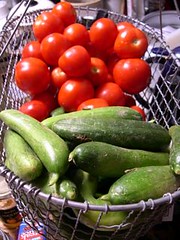
In the meantime, look at these beautiful beefsteak tomatoes from Lisa's Petals and Produce, round zucchini from Blossom Hill, and cherry tomatoes from Natural Trading Company. Scrumptious! And then there's the locally produced, hormone-free bacon and sausage from Coffee Pot Ranch. DH is making a vegetable and sausage soup for dinner. It's summer dining at it's best.

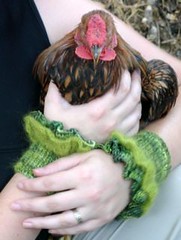
And here is my fledgling rooster presenting one of my favorite comfort foods, chicken pot pie! We have been letting the chicks run around in the back before they begin their tour of the property in their chicken tractor. They have become confident enough to explore the front area of the house. One morning I came out and couldn't see or hear the chicks. As I'm listening more closely, Cassie, one of our cats, comes tearing around the corner from the front of the house, followed closely by the chickens! The cat took refuge behind my legs, while the chickens skidded to a stop in front me. When questioned, no one had anything to say, not a meow, nor a peep!

Thursday, June 26, 2008

Chicken Update - It's a boy!

Many of you have expressed your sympathy regarding our sick chick (thank you) and have asked for the next update about the rest of the "flock". The chicks are growing well and seem to be happy and content. They're really doing a number on the weeds. They have already cleared the area in front of our studio and beg my husband to be moved in the afternoons when he checks on them after work. They also have an endearing habit of running up to greet me when I squee at them.

Also, we have determined that one of our Wyandotte females is actually a male. No, he's not a gender challenged young chick, but obviously determining the sex of baby chicks is not a precise process and we got the result! Can you pick him out in the group photo? He's the one with the burgeoning red comb.

By the way, green legs on the Americaunas indicates green eggs from them in our future. Now to find green ham... Sources anyone?

Thursday, June 12, 2008

On a Happier Note


Condo living - chicken style!

The chicks have been enjoying their new accomodations outside since Sunday. Each day their portable coop, also called a chicken tractor, is moved to fresh ground. They love to scratch for bugs and seeds in addition to their chick feed. We have them in an area that has been a milk thistle patch for the last couple of years despite efforts to get past it - I'm hoping that the chickens will take care of the seed load in the soil.

The coop is heavy enough to keep out most predators like bobcats, raccoons and foxes. They have fresh water daily, a place to perch and a safe area in the back half. For the moment the coop is very close to our studio so that we'll be able to hear any problems, and is also under the shade of the oak trees. We'll wait to move the coop into the open until they're older and bigger, at which time half of the coop will be covered in shade fabric.

Sad News

I suppose it's inevitable to expect casualties amongst your livestock, but heartbreaking nonetheless.

We awoke this morning to find one of our Buttercup chicks collapsed in the coop. She was chilled, couldn't stand or move her feet and legs. We brought her inside, cocooned her in toweling and on top of a heating mat on my lap to bring up her temperature, while we tried to figure out what was wrong.

We believe she had Marek's disease, a virus specific to chickens. There a few different forms of the disease, and she was presenting with classic Marek's, with leg paralysis. We kept her separated from the others, and tried to get her to eat, or at least drink. However, when the afternoon rolled around with no change and she still wasn't drinking water, even when we dipped her beak into it, we came to the hard decision to put her down. Huge thanks to my husband who wanted to spare me the agony of that process, and took care of everything.

There's no cure for Marek's. The terrible thing is that they can be vaccinated at birth against the disease, but the chicks I purchased from a feed store in Grass Valley were not vaccinated, so it's possible that the other three chicks from that location may also sicken, and have to be killed in turn. I'm waiting on information to see if I can still vaccinate the others, though if they are already incubating the disease vaccination will be pointless.

On the upside, my two Wyandotte chicks were purchased at a feed store in Auburn, where they request all of the chicks to be vaccinated as a matter of course. Also, a friend with poultry stated that he's rarely had more than one bird die at a time from Marek's or other diseases, so it's possible that the others will be ok.

Thursday, May 29, 2008

I've got my eye on you!

My chick babies are getting to an age where personalities begin to emerge. Just look at my Ameracauna - no names yet, but she's already emerging as the ring leader of the flock and is rapidly becoming my favorite. You can see in the picture that she's frequently keeping an eye on me. The other Ameracauna is almost as canny but is definitely playing second fiddle. The Wyandotte babies are a week younger than the others and still have a distinct pinball quality as they run around and under their cell mates.

The cold weather has prevented any field trips to the great garden outside. The cold is also slowing down bean seed germination. I may put up some floating row cover to warm up the soil, and maybe put the chickies in there too. The chicks need to remain between 85° and 95°F to stay healthy. You can see their feathers are growing in, but it's a slow process. In the meantime they must be protected from drafts and kept warm. There is a heating pad under one corner of their cage and a heat lamp, which allows the birds to self-regulate inside the cage.